Crystalising value
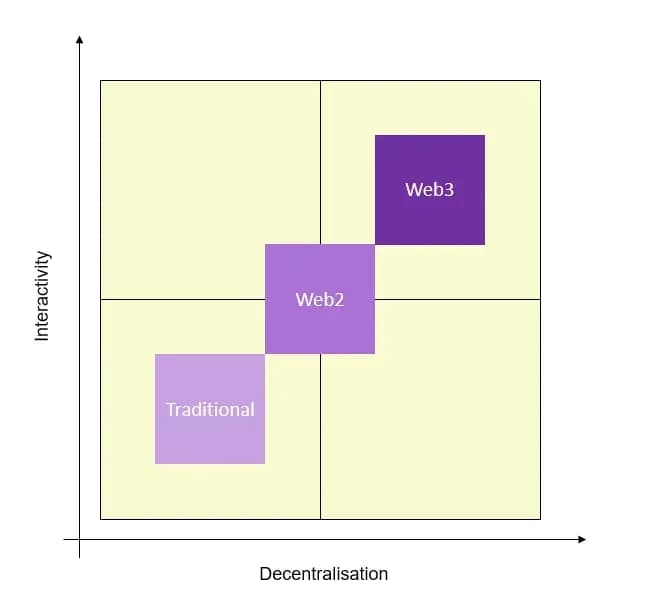
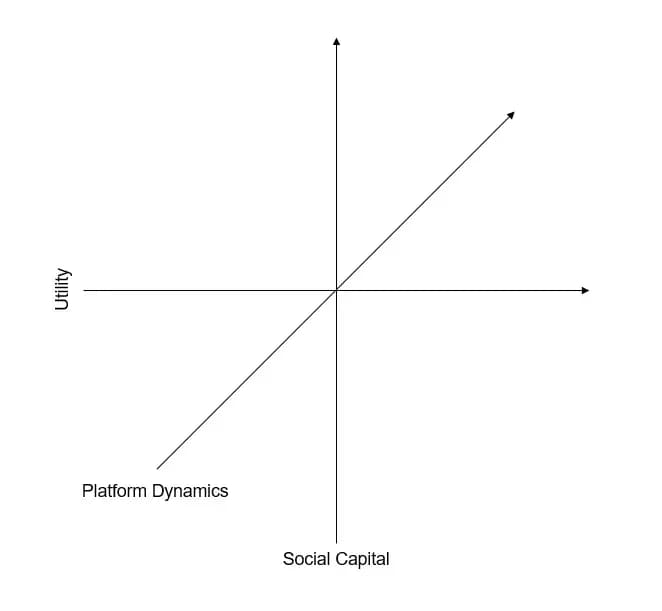
I think where Web3 communities differ greatly is that there is a shift towards attempting to crystalise value in social capital, utility or platform dynamics. By attempting to attach value to some of these community components, Web3 communities aim to create economies and more sustainable flywheels around communities. For the most part, a lot of what a Web3 community means is still at a very nascent, experimental stage. However, the general trend is shifting towards allocating economic value and thus decentralising ownership over a platform and community, with proto-Web3 communities shifting into more established Web3 ones we see today.
Proto-Web3 communities for the most part piggybacked off of existing Web2-styled communities, but attempted to integrate some degree of economic incentivisation for adoption and valued contributions. This effectively created the first differentiating factor that would be made increasingly complex and in-depth over time, encapsulating more and more of the various factors that make up a Web2 community.
Case Study: Bitcointalk
Many of the earliest communities in the Web3 space arose on the basis of Web2 communities. Bitcointalk for instance, an OG platform where the cryptocurrency community used to coalesce around, would arguably be one of the first Web3 communities to actually exist. While at the heart of it, Bitcointalk is just a Web2 type forum community, it also had primitive economic incentivisation mechanisms. For instance, there were faucets that paid out free BTC to people who would sign up on the forum (not anymore). People got what was the equivalent of airdrops of BTC to incentivise participation in the community. While this gave little ownership over the Bitcointalk forum platform in of itself, part of the platform dynamics was incentivised by providing greater utility to its users (to get and participate in the BTC network).
As we move from these proto-Web3 communities, we gradually see a move towards airdrops and participating in bounties for airdrops. For much of the 2013 and 2017 cycles, the Bitcointalk forum became sufficiently mature, morphing into one of the key fixtures in the Web3 community landscape. As such, a lot of new projects started piggy backing off of the forum, launching airdrop and bounty campaigns for users who interact with their projects and protocols. These formed the next wave of what Web3 communities were like. For the most part, most projects used airdrops to greatly enhance the utility their community offered, while also utilising those airdrops to incentivise improvement of their platform dynamics (onboard genuine users, generate relevant content / user input). In my time at an ICO advisory business with friends and later in a large regional exchange (Quoinex, later Liquid and then FTX Japan) where I helped them raise one of the largest ICOs in Japan, I worked along and facilitated such industry dynamics. Initial adopters of Web2 platforms enjoy an easier path towards accruing greater social capital, which might be able to be monetised down the line. In the Web3 space, adoption is usually directly rewarded, and users can choose to continue holding the rewards in hope of future gains or take profits and leave.
That being said, this is still an incredibly primitive means of integrating incentive and economic models around sustainable flywheels and communities. Control is largely centralised, and for the most part, the stake users get in the success of the community was often not directly linked to the tokens they got for their efforts.
Decentralised Autonomous Organisations (DAOs) are usually what people think of when we speak of a “modern” Web3 community, even though I would argue that the category is much larger. In DAOs, certain stakeholders are given the power and responsiblity to collectively decide on what the organisation does via voting, which represents a deep shift from how a Web2 platform would function (ownership wise).
DAOs probably also had their initial ties from Bitcointalk, with the BTC core development community. While many of these developers do not actually gain a stake in BTC’s success just because they have made contributions to the BTC core project, they are actually able to contribute to the code base of BTC, discuss and collectively make decisions. I believe this decentralised community, much akin to the Four Leaf Studios / 4chan game development case study shared above, was where DAOs found their roots. Moving from foundation type opensource and distributed development work, ETH was probably one of, if not the first, to attempt a DAO that we would more commonly recognise today. It was called “The DAO”, and was supposed to act like a decentralised venture capital fund, a concept similar to some of the DAO funds we do see in the space right now. The DAO raised funds in ETH and gave out LP shares-esque (Limited Partners - people who fund private funds get shares in return to represent the stake that was purchased) tokens that would have allowed holders to vote on fund allocations towards various investment opportunities. While a hack that exploited a smart contract vulnerability did result in The DAO shuttering and causing a massive rift in the ETH community, this became one of the key moments in Web3 history that moved the needle on what a Web3 community could be.
With this important context, I think the biggest development for Web3 communities thus far would be around identity and crystalising status as a form of currency. Moving beyond solely just being a voting shareholder or someone who gains cryptocurrencies for communities, identity and status allows communities to engage with users and build culture and branding on a far more personal level. In Web2 communities, the idea of what status and identity represents is incredibly abstract and often ephemeral. While it is completely possible to build a personal brand and status over time, it is often not directly monetisable or transactable. Where it differs wildly in the Web3 space is the attempt to not only give users a slice of the pie, but to also build a space within which they can attach market value to identity in the form of NFTs (Non-fungible tokens - tokens that can be distinguished from one another). Conversely, people are also encouraged and sometimes even expected to attach and grow identity and status around those assets. This allows for virtuous flywheels that is centred around distributed brand image development and value creation.